| Property Matters – The EFCL Query
Part 1
Published Sunday July 3rd, 2011
Continuing the series
of examinations into the purpose and performance of our State
Enterprises, this week I am looking at an important issue which seems to
be emerging at the
Education Facilities Company Ltd. (EFCL).
EFCL is a state-owned
company involved in the building and maintenance of schools. It consumes
public money in the execution of its functions and that is why it is
important to put these points now.

One of the biggest
public concerns is the high level of white-collar crime, which means
bribery, corruption, fraud, over-billing, ‘back-fitting’, tax-evasion,
asset-stripping and so on. White Collar crime is a growth industry,
since the rewards are very high, while the risk of being caught or
punished is extremely remote.
Due to the size of the
State, a great deal of that white collar crime can be found in State
Institutions. Once Public Money is being spent, we must demand a high
standard of accountability and transparency.
In terms of
principles, there needs to be an appropriate balance between the
long-established ‘Right of privacy‘ in commercial transactions
and the growing ‘Right to know‘ which is part of the emerging
social order. There will be different views as to where the correct
balance exists and furthermore, the consensus position will shift as
time passes.
It seems to me that
the default position should be that, in doubtful cases, the right of the
public to information should prevail, since we are the ones paying the
costs. Indeed, that position forms part of the Freedom of Information
Act, so that is substantial support.
In early 2009 we
witnessed an attempt by the then PNM government to amend the Integrity
in Public Life Act (IPLA) so that people reporting breaches of that Act
would have been forced to give their names and addresses. That
arrangement would have given even greater protection to corrupt
officials, since virtually no-one would want to make a report. Of course
people are strongly encouraged to report ‘normal’ crime like rape,
robbery, murder and so on – further encouragement is offered by allowing
them to make anonymous reports via
800-TIPS, for example. Those proposals to amend the IPLA would have
encouraged corrupt behaviour by reducing the reports.
That
Bill was piloted by then Attorney-General, Bridget Annissette-George.
The proposals were strongly opposed in the Parliament and in the wider
society, eventually being withdrawn. One of the strongest protestors in
the Parliamentary debate was Dr. Tim Gopeesingh, who was reported to
have accused the government of trying to intimidate people into not
making reports. [Hansard,
1 May 2009 p.441] On that occasion, the Standing Orders were used by
the Speaker, Colm Imbert, to curtail Gopeesingh’s presentation. [Hansard,
1 May 2009 p.455]
The normal good
governance provisions for annual accounts, Board Meetings, minutes and
so on are very important. But those provisions must be supplemented by
an atmosphere and a series of institutional arrangements which
facilitate Whistle-Blowers. There must be clear channels and protection
for Whistle-Blowers if we are to have any chance of reducing corruption
in our country.
Without the assistance
of Whistle-Blowers, we would not have known of the Piarco Airport or
UDeCoTT fiascos and we know for sure that somebody leaked the file on
the Heights of Guanapo Church just prior to last year’s election. We
need encouragement for Whistle-Blowers – in some countries they are even
given big cash rewards. The JCC has been active with its partners – TTMA,
the Chamber of Commerce and the Transparency Institute – in making
Public Procurement proposals to the Joint Select Committee. An important
element of those proposals is the creation of proper channels for
Whistle-Blowers.
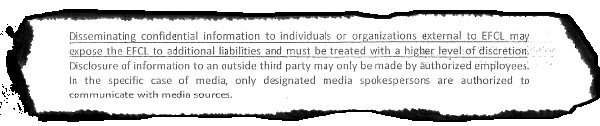
I recently received
a copy of some EFCL documents, which were stated to be their new
Confidentiality Policy Statement and a Staff Confidentiality Agreement
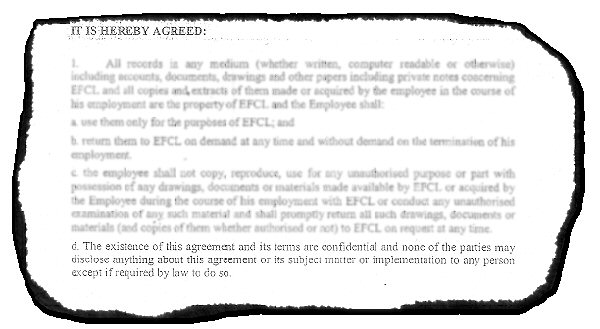
for the signature of employees. I was also told, separately, that EFCL
staff are being required to sign that Agreement, under threat of
dismissal. What is more, the Agreement contains a specific clause which
forbids revelation of either the existence or the terms of the
agreement.
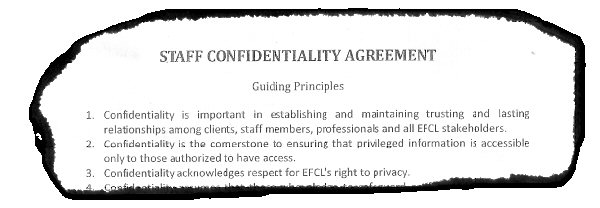
If those documents are
genuine, there are serious grounds for concern, so I made a written
query via email on Friday 1st July
to the EFCL’s CEO, Paul Taylor, and its Chairman, Ronald Phillip. I
outlined what had been reported to me and asked these questions –
|
From: Afra Raymond <afraraymond@gmail.com>
Date: Fri, Jul 1, 2011 at 1:13 PM
Subject: EFCL Confidentiality Policy
To:
paul.taylor@efcl.co.tt
Cc:
ronald.phillip@efcl.co.tt
Hello Paul,
I am reliably informed that EFCL staff were
recently directed to sign a ‘Confidentiality Agreement’, the rationale
being that it is the new Company policy.
Before taking this any further, I am requesting
your written response to these questions -
1. Is
there a new EFCL Confidentiality policy? When did that come into effect?
Would you please provide a copy of that policy?
Assuming a new Confidentiality Policy is in place,
these are my queries -
1. Was
that policy approved by the Board of Directors?
2. Is the
Ministry of Education aware of this new policy?
I would appreciate a timely response.
With best wishes.
Afra
Raymond
|
That email was also
copied, purely for information, to the Minister of Education. At the
time of writing, there has been no acknowledgment or reply.
This is a serious
development for these reasons -
1. The
Super-Confidentiality provisions mean that staff are forbidden to obtain
any advice, which seems to be a breach of good labour relations, at the
very least.
2. The
unilateral imposition of this new document does violence to the proper
meaning of the word ‘Agreement’.
3. The
‘Guiding Principles’ at page 2 refer to ‘privileged information‘
and ‘EFCL’s right to privacy‘, both of which seem to me to be
leading away from greater transparency and improved procurement
procedures – which leads into the final point
4. This
administration promised, both on the campaign trail and post-election,
to make new procurement legislation a priority. The Joint Select
Committee on Public Procurement was Chaired by Dr. Tim Gopeesingh,
Minister of Education. EFCL is the principal State Enterprise within the
Ministry of Education, so what is Dr. Gopeesingh’s position on all this?
Is this taking place with Dr. Gopeesingh’s knowledge and/or approval?
It is clear to me that
this kind of stealthy restriction on the possibility of staff becoming
whistle-blowers is incompatible with the high-profile public statements
of support for a new, effective public procurement system. Those
statements range from the promises at page 18 of the
People’s Partnership Manifesto to numerous speeches by the present
Prime Minister.
The reality is
inescapable -
Expenditure of
Public money – Accountability – Transparency = CORRUPTION
I am closing by
wondering, aloud, if this is the shape of the new Information policy for
our State Enterprises.
Afra Raymond is President of the Joint
Consultative Council for the Construction Industry (JCC) and Managing
Director of Raymond & Pierre Limited.
www.raymondandpierre.com or
www.afraraymond.com. |