| Property Tax – An Overview
Published Thursday October 8th 2009
The recent proposals
for a revision of property taxes have met with a heavy round of
criticism. Apart from the Government, there have been few supporters for
this new tax. That is not surprising since our country is entering an
economic slowdown. In terms of timing, the move was poorly judged, in my
opinion anyway. That said, I believe that a revision of our property
taxes is long overdue.
This series is
intended to provide some basic information on this important series of
questions. Most objections have been based on obvious dissatisfaction
with some government service or other. Only some of the objections have
been on the question of timing. It seems to me that the greater part of
the protest is flowing from the level of dissatisfaction with the
standard of government. That is beyond the scope of this particular
series. I have already spent most of the previous articles in Property
Matters highlighting the many strategic shortfalls which have a bearing
on the property arena.
This series is to
provide information on property tax only.
An engine of wealth
In this society,
property is both a place to live or base ones business and a means of
making money. Every successful person in the society has made a
significant part of their wealth from dealings in property; buying and
selling, fixing-up, renting-out, buying lands and cutting out lots for
sale, and so on. The taxation measures for the sector are generally very
light, which is why dealing in property is such a popular way to make
and hide great sums of money. Amidst all the recent discussion on the
pros and cons of the property tax review, we have had no real
perspectives on its place in the country’s tax revenue.
According to the
Estimates of Revenue published by the Ministry of Finance, in 1995
property tax was 2.0 per cent of tax revenue and in 2009 it was expected
to be a mere 0.18 per cent. Proportionally speaking, property tax is now
less than one-tenth the size it contributed 15 years ago. Even when one
takes into account the predicted increase in property taxes to $325
million in 2010, the proportion contributed by this source is expected
to be 1.06 per cent of the whole tax revenue. Now, while this dramatic
decline in its proportions is also due to the immense increase in the
size of other types of tax revenues, there are other aspects which are
revealed on a closer examination. When one considers the immense stores
of wealth which are held in property, beyond the basic family home, it
is sobering to realise how little the sector contributes to tax
revenues.
Modes of Property Tax
There are four modes
in which property is taxed in a modern system:
1. Stamp duty or
transfer tax: This the tax paid by the purchaser when acquiring a
property. This is the only one of the four types of property tax which
is working to some extent. Most lucrative property investments are
nowadays held in company names so that they can be split and sold by
transfers of shares, which attracts a fraction of the stamp duty payable
on a sale of property. More on that later.
2. Occupation tax:
This is the tax paid for the length of time one owns or occupies the
property and this is the one being revised now. It is called either land
& building taxes or house rates under our laws. This is not working at
all in our country and more figures will be presented in support of that
point.
3. Income tax on
rental income: This is taxes payable on the income received from
property rentals. This is poorly monitored at present.
4. Capital gains tax:
This is a tax paid on the profits made when property is sold. CGT is
only payable here in the cases of property disposals taking place within
12 months of acquisition. Few vendors dispose of property within that
time-limit.
T&T Revenue Authority
The TTRA was launched
in June 2009 and is intended to be a unified body to collect taxes and
customs duties. The Board of Inland Revenue and the Customs and Excise
Division are to be merged. Some of the cited benefits of the TTRA model
are improved revenue generation and compliance with the country’s
revenue laws; better services to taxpayers and traders; a more
professional staff complement; an improved retention of qualified
personnel; and, an improved capacity to deal with corruption. Those are
objectives with which we fully agree and the property tax review under
discussion must be understood as a part of the transition to the TTRA.
There are substantial challenges for the TTRA in this area and we will
be pointing these out in this series. As a conclusion to this readers
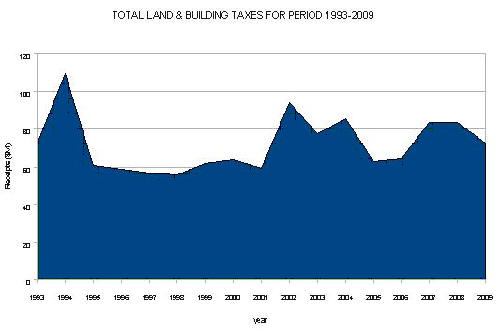
should consider the actual amounts earned by Land & Building Taxes
according to the official figures.
Land & Building Taxes
receipts
Year Receipts ($M)
1993 72.04
1994 109.38
1995 60.89
1996 58.64
1997 56.63
1998 55.78
1999 61.56
2000 63.90
2001 59.11
2002 94.08
2003 77.50
2004 85.54
2005 62.68
2006 64.35
2007 83.72
2008 83.77
2009 72.77
2010 325.00
2009 and 2010 are estimates
Afra Raymond is Managing Director of Raymond & Pierre Limited.
Comments can be sent to
afra@raymondandpierre.com |