| Government must allocate monies so
public servants can maintain State property
Published
Thursday 18th November 2004
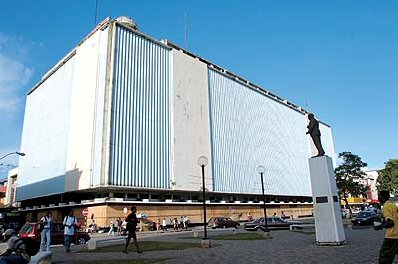
Salvatori Building, Port-of-Spain.
Photo: Karla Ramoo
Recently, as we discussed the burning
issue of non-maintenance of State properties, we had reports on the poor
condition of the San Fernando Magistrates’ Court and the disputed State
“repossession” of Mille Fleur from the Law Association, said to be
necessary to prevent further deterioration.
One of my favourite quotes is from Albert
Einstein, who defined idiocy as “endlessly repeating the same process,
hoping for a different result.” Some food for thought as we strive to do
better at managing our limited resources. Do we have the capacity to
learn from our mistakes and improve our results?
Some of the policy options in correcting
the mismanagement of State property are as follows:
The State policy on land management is
set out in a 1992 document, which does not seem to extend to bodies such
as Caroni, Petrotrin or the various Local Government bodies.
As a result, there are illogical and
inefficient rent levels between various areas, with some prime property
earning the State the same rents as in more remote residential areas.
What to do? Should prime rents be
increased or residential rents be reduced?
There are other management issues in the
cases of leaseholders who wish to change the permitted use of the
property. An example of these inconsistencies is in the sidebar. There
is no sense that there is a policy for our State properties which is
part of a whole aimed at national development.
No sense of alignment with various
medium-term targets related to school-feeding, employment or the
development of niche agriculture or manufacturing.
The document sets out a series of
administrative arrangements and is actually silent as to the vital role
State property has to play in the wider development of the society.
How is State property allocated? There is
a long-held belief that lucrative leases are granted to those who find
political favour and one way in which this has been dealt with in the
past is the system which forces the most routine lease renewals to be
subject to presidential approval.
The mistaken belief that this will
somehow comfort a suspicious public is almost as bad as believing that
the Head of State actually vets the documents. The various documents are
approved on the recommendation of the relevant public servants.
The public servants still operate the
system and wield the power. All we have done is to erect another useless
layer of bureaucracy, which only acts to delay.
We also recently had newspaper exposés on
the alleged takeover of State-owned quarries and the attempts by the
responsible minister to explain the position.
The picture is still very unclear, but we
are left with the impression that, were it not for those exposés, little
would have been done to address the alleged non-compliance with the
terms of those leases.
Can it really be acceptable to grant
leases of property worth millions of dollars if there is no commitment
to actively managing the portfolio?
Those are taxpayers’ properties and we
need to ensure that leaseholders comply with the terms of their
agreements.
To do otherwise would be a gross
mismanagement of the public assets put into the trust of politicians and
senior civil servants.
Again, we can be sure that none of those
people would treat with their own properties in this slack fashion.
The poor salaries and consequent staff
shortage in the relevant parts of the public service will be the subject
of the next column, but we need to register that this poor management
has serious long-term consequences.
Of course, we would need to ensure that
our public servants have the necessary monies to maintain the properties
which are their responsibility.
One way to begin might be to allocate
maintenance funds as a percentage of the cost of the properties in the
particular areas.
This would need to be checked by
examining the extent to which the allocated funds were expended and the
level of maintenance.
It would be untrue to say that there are
no examples of properly-managed State property and we need to learn from
those.
The Twin Towers, Brian Lara Promenade and
San Fernando Hill are well-maintained public properties despite their
heavy use. The conception and maintenance of these need to be examined
so that the positive practices can be reproduced.
In Woodbrook—ie south of Tragarete Road—a
leaseholder can obtain permission from the landlord—in this case the PoS
Corporation—for a change of use from residential to commercial on
particular streets.
A typical Woodbrook residential
leaseholder pays about $0.33 per sq ft and the change of use would
increase this to $1.00 per sq ft.
In St Clair, which is north of Tragarete
Road, a leaseholder can obtain permission from the landlord—in this case
the State—for a change of use from residential to commercial on streets
south of St Clair Avenue.
The cost of this change of use is about
$140 per sq ft.
Next week we will look at the
organisations responsible for the management of State property. |