| The Management of State property:
Whose business is it, anyway?
Published
Thursday 4th November 2004
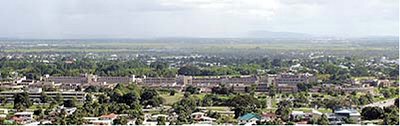
Eric Williams Medical Sciences Complex, Mt. Hope.
Photo: Shirley Bahadur
This week we begin to draw together some
of the matters related to State property which we have touched on in the
past.
We will examine this in three
parts—today, we begin with a look at some of the key issues, followed in
the next fortnight by a discussion of the policy options in dealing with
those issues and we will end with the various State bodies which are
responsible for this critical area.
In order to draw proper conclusions, it
is important to set out the nature and extent of state property. For
most of us that phrase would mean state lands, including estates like
the Petrotrin and Caroni lands. While that view is essentially true, the
fact is that state property extends far beyond those areas and would
include other parts such as the leasehold estates. Some of these are St
Clair, Woodbrook and the other leasehold estates in areas like Diego
Martin (River Estate and Diamond Vale), Santa Cruz and so on.
Although it is beyond the scope of this
series, we should note that our mineral and seabed/marine resources are
also part of the stock of state property.
The key issues which emerge in
considering the management of state property are—maintenance—This one
has to be top of the list. Unless you are building property for sale,
maintenance is a critical issue to all property investors and, in the
case of state properties, we have perennial concerns. We are all fed-up
of the sight of crumbling public buildings—post offices, police
stations, schools and so on. To me, they speak to a kind of contempt for
the taxpaying public who have to use these facilities, not to mention
the public servants who are also bound to put up with the deplorable
conditions.
We hear very often, from both political
parties, of the drive towards “developed nation status.” If we are to
have any chance of achieving that goal, we need to develop new norms for
the maintenance and cleaning of public property. The simple fact is
that, as our elders taught us “A stitch in time saves nine”; it is
cheaper to regularly maintain a property than to carry out last-ditch
repairs. It seems to be the norm here to let one of these vital public
buildings reach a state of virtual collapse before announcing either an
expensive series of repairs or, even more questionable, its replacement
by a new building. To put the issue in economic terms, when one of these
properties reaches that point of virtual collapse we have depleted that
asset prematurely by mismanagement.
It’s like buying a new car, which ought
to give five to seven years’ service and then destroying the engine by
failing to service it regularly.
Project fever
Following from the last point, in a
situation where the State seems incapable of managing its assets, we are
also accustomed to the regular announcements of mega projects.
From the Mount Hope Complex ,at a time
when the existing hospitals were (and still are) crumbling, to the wave
of new police stations put up by the UNC while others were crumbling,
the picture is not encouraging. Quite a few of the “new” post offices
and police stations are now themselves in need of basic maintenance.
Yet, the new projects are announced at a
dizzying speed, from the new ministerial buildings—health and public
administration to name just two—to the new revenue authority complex to
house Customs & Excise and the Board of Inland Revenue. One is bound to
wonder at the sense of all this. Will they be eyesores in the next
decade?
When we consider these matters, it is
important to know that, because property is such a long-term investment,
the decisions we make today have long-term impact.
We are thinking about the alleged
corruption almost 50 years ago in the allocation of gas station sites.
The result is that we have three such in lower Maraval, within yards of
each other, while St Ann’s/Cascade has none. Even though we know what
went wrong at that stage of our development, we have been unable to
right the misallocation of resources.
These are our resources and we can be
sure that no minister or senior public servant would allow their home or
businessplace—yes, we know that ministers are not supposed to have
businesses, but you know what I mean—to crumble in that fashion. The
lesson can be applied in many other areas if we think about it.
It is the largest and most unknown
territory we know, but face it we must. A good beginning is to honestly
consider the errors of the past.
We need a strategy to deal with the needs
of the future.
Next week we set out some policy options
for the management of State property.
|