| Our Planning System - Part 2
Published
Thursday 16th September, 2004
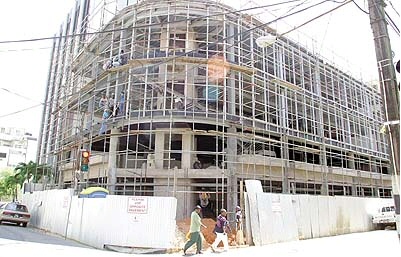
Construction at Corner Duke and St Vincent Streets, Port-of-Spain.
Photo: Lester Forde
This week we continue to look at our
planning system and its impact on property values here. As we mentioned
last week, there is a permanent tension between the constitutional
rights of landowners to develop their property and the duty of the
planning authorities to limit those rights. We need to note that there
is also a tension between the landowners themselves. This is because the
interests of those who have already developed their land can be in
conflict with those who are yet to do so.
For example, the development of more
apartments or houses would have the effect of increasing the supply and,
all other things being equal, slowing the rate of price and rent
increases. This is not normally welcomed by property owners, although
some of them have the view that any development is good for their area
since this would lead to higher values generally.
There are other possibilities mentioned
last week, such as the loss of a scenic view or the reduced peace and
quiet with the arrival of new neighbours. All these are examples of
matters in which the planning authorities have a role in mediating the
needs of both sides.
Some issues which our planning system
should address in the future include:
(1) Urban renewal
We have described in previous columns the
likely long-term impact of today’s planning decisions in the granting of
planning permission for large commercial buildings outside our
traditional city centres.
When this trend is considered alongside
the continuing decline of those city centres—due to generally
unappealing conditions, heavy traffic, inadequate parking and public
transport—we can see that planners have a responsibility for urban
regeneration.
Is it a good use of our limited
“developable” lands —in an earlier article, we detailed that only nine
per cent of T&T is flat and non-agricultural—to allow our city centres
to decay while consuming ever more of that limited resource?
(2) Unit sizes
Earlier on in this series of columns, we
had cause to criticise certain State property management policies as
being “one size fits all” and therefore inherently inefficient.
It has to be said that some of that
criticism could also be levelled at private developers who sometimes
appear to be emulating these State policies. Of course, I am referring
to the fact that we live in a society with diverse needs and a falling
size of family unit.
This results in part from the rising
number of single person households, single parent families and retirees.
Despite this market reality, there is almost no variety in the output of
our private sector housebuilders—it is virtually a guarantee that
townhouses and houses for sale will have three bedrooms, the exceptions
are extremely rare.
What this means is that there would be
significant numbers of people at the very margins who could only afford
to buy a smaller unit than that offered for sale.
In other markets the planners would
intervene to ensure a greater and more appealing range of choice by only
giving consent to proposals which addressed those concerns.
Some say the private sector is better at
allocating capital and, therefore, developers should make this sort of
choice. But the role of our planners ought to be to balance the
developers’ inclination towards cutting costs by reducing choices of
units with the need for variety from the purchasing public.
(3) Info access
A serious reform of the planning system
is needed in the area of public access to information on the development
control process since only a limited amount of information is available
from the planning register.
The register will tell a member of the
public what planning permission has been granted on a piece of land and
that only in bare outline.
One is simply unable to determine the
applications on a particular piece of land: the precise details of what
is approved—i.e. how many floors, shape/footprint of the development,
unit mixes (accommodation and number of buildings, etc)—far less see the
plans which are approved.
We are told that that is a private set of
information and its release is not covered under the law. We would
suggest that a more modern, participative planning system needs to have
this information readily available since applicants are submitting their
details for approval and we the public need to see what is proposed in
our neighbourhoods.
(4) Development & public access
We are all familiar with what happens
when some large buildings are being constructed and the pavements are
blocked. In addition to this inconvenience, we can get the impression
that there is little effort to reduce the period in which we have no use
of the pavements.
Is this permitted? Are there any measures
that planners can take to stop this or at least minimise the period of
inconvenience?
We need to make a determined effort to
adopt longer-term thinking about the future shape of our society if 2020
is to be a better time to raise our children. Long-term thinking for a
viable future must involve unpopular choices and delaying today’s
benefits for tomorrow’s.
Our political parties all exist on a
five-year treadmill while landowners want to develop their properties
now; planning for our future is the only way to manage these tensions.
We must, in era of instant gratification,
be mature enough to change our thinking. Can we?
Next week: We conclude our examination
of the land-use planning system and its impact on the real estate
industry. |