| Throwing out the baby
Published
Thursday 30th May, 2004
| ROYSTONIA:
Investigation or Distraction?
Over the last fortnight there have been
a series of claims and counter-claims in the controversial Roystonia
housing scheme. How can we try to make some sense of the confusing new
picture? Do we want to know what really happened?
This is an opportunity to clarify and
improve national housing policies; it would be a pity to miss it. What
was the rationale behind the Roystonia contract? Is that rationale
effective for delivery of low-income housing? How heavily does it
consume taxpayers’ dollars? Are there better methods available to us?
Of course, there have been accusations
that the Housing Minister’s calls for investigations into this matter
have been nothing less than a series of distractions. We can all
remember episodes in which our politicians have tried to distract us
from one embarrassment or another. It would be easy to assume that this
is the case here. The critical importance of housing to the national
well-being, the size of the identified housing needs and the scarcity of
the critical resources all mean that this is far too important a matter
for these easy assumptions. How can we evaluate these accusations?
To properly decide on that question,
there are some questions we would need to have answered –
|
-
Tendering – I have read both NHA and Hanover statements on this
matter with conflicting claims of no tendering and competitive tendering
respectively. Which is true?
It is possible to use resources to
produce quality houses without competitive tendering. Building
contracts can be settled by negotiated tender with contractors, but
these would need to be monitored by reference to prevailing costs and
quality norms to ensure value for money and standards of quality.
Of course, our norm is for public works
to be tendered – the reason behind the establishment of the Central
Tenders’ Board – but that has been changing over the last few years. If
there are good reasons for the changing of that system, we need to learn
these publicly and have the appropriate cost and quality measures agreed
by the respective bodies – NHA, UDECOTT, NIPDEC, JCC, Hardware dealers
etc. Does the present housing program use the competitive tendering
system or have we diverged from these? Again, for the sake of clarity,
there is nothing wrong with trying something new once the necessary
safeguards are in place.
-
Risk allocation – One of the more serious criticisms of the Roystonia scheme is that the contract seems to have allowed rises in
construction costs to be passed onto the NHA. Do the present wave of
contracts restrict that risk to the building contractors?
The entire rationale behind using the
private sector for public provision is their greater efficiency at a
number of things, including the critical area of risk. If agreements
between the public and private sectors do not allocate risk to the
latter, the rôle and utility of these is questionable, to say the
least. Once again, we can support changes to this, but only if the
risks retained by the public are matched by corresponding benefits.
-
Cost of building - We recently heard the Minister of Housing
voice his serious concerns over the rising prices of building materials
and the adverse impact this was likely to have on the thrust to build
affordable housing. Appropriate procurement methods and the associated
allocation of risk are critical for the attainment of the government’s
ambitious targets. There ought to be significant savings in any volume
building program. We need to learn to what extent the Roystonia homes
were more or less expensive than the prevailing norms for houses of that
size and standard. How does the output from the present housing program
measure up? Has our performance improved? Are we getting value for
money? If not, why not? What can we do to improve that performance?
-
Monthly payments – We read reports of NHA statements that monthly
payments exceeding $4M were being made to the Roystonia contractors.
These are large sums of money and moreso when we consider that it is
almost the whole of the capital expenditure on housing. This table
compares the actual capital expenditure on housing (obtained from the
Ministry of Finance publication Estimates of Expenditure) with the
recent Roystonia figures as reportedly stated by the NHA.
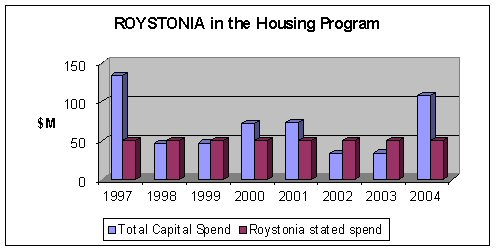
The
comparison is striking since in several of the years the stated
expenditure seems to exceed the reported totals. There are several
possible explanations and these are set out here, in no particular order
- the $4M figure of monthly expenditure is incorrect or correct figures
have been mistakenly published by the newspapers: the Estimates are
incorrect: the entire project is, for some reason, not meant to be shown
in the Estimates. The questions are fertile and others occur; how could
one scheme, even if it were not part of the officially reported
expenditure, consume so many resources? One could also ask how what is
obviously the NHA’s biggest scheme is only now receiving attention.
The directors of Hanover Construction
have made their protests of innocence and we need to guard against
creating an atmosphere which discourages private sector participation in
national development. We are already very close to that point. We need
to clear the air and be constructive if we are to develop.
We have to learn from our experience if
we want to do better. It is an essential part of growing up. Do we
want to do better?
Next week, we begin to discuss the
future of our cities, beginning with our troubled capital. |

| Over the last fortnight there have been a
series of claims and counter-claims in the controversial
Roystonia housing scheme. How can we try to make some sense of
the confusing new picture? Do we want to know what really
happened?
This is an opportunity to clarify and
improve national housing policies; it would be a pity to miss
it. What was the rationale behind the Roystonia contract? Is
that rationale effective for delivery of low-income housing? How
heavily does it consume taxpayers’ dollars? Are there better
methods available to us? |
|